skip to main |
skip to sidebar
 The #32 bus, a tiny electrified box with only 9 seats including the driver's, but at least 20 passengers, bounces up the steep and narrow streets to, almost!, the visitor's center of the Alhambra. We all get out and mill around for a few seconds trying to orient ourselves. Further up the hill at the center, there always seems to be a long line with people in it telling you they've been there at least an hour. On the other hand, if you have a money card with a PIN you can bypass the line and go to the computers and buy your tickets immediately. Why do so many people wait in line? The voices over the intercoms that suggest the machines speak at least four languages, most visitors should understand at least one. It's the lack of the PIN that does it, I think... Or maybe we are all just sheep!
And so, the second and third times around and knowing the trick about the timing for entrance, I was able to visit the palaces...
 Last post I left off in the Mexuar Palace, the first that visitors encounter. This shot is a look back at the "Golden Chamber" where it is thought that visitors in the days of the Moors waited in the hopes of an audience with the Sultan.
Being an ignorant fool, I spent a few minutes wishing that it was 1400 and that I was there trying to convince a courtier that my case and I deserved a hearing from the Sultan himself. Being someone who lives in the era of macmansions, I was also surprised at the smallish scale of the palaces.
 The Golden Chamber has a beautiful view, of course, but also an incredible ceiling which is mostly original with some Catholic motifs and lots of gold added during later restorations. This type of work is called Mudejar and is a kind of carved wooden mosaic. After Baobdil was defeated, many Moorish craftsmen were allowed to stay and continued to work on Christian buildings. This is one of the reasons southern Spain looks the way it does even today.
Even the drains are beautiful!
On the other side of the courtyard  is the "facade" of the next palace, the Comares Palace. I use quotes because this architecture didn't really have facades; it was very plain on the outside and only became sumptuous on the inside. So, you can't really call it showy, I think, since its form and decoration was more for the comprehension and pleasure of the occupants than it was an outward show of wealth or power. Hard to see in these photographs are the many inscriptions in the wall carvings that include poetry and admonishments to good behavior.
This shot is looking up  at the beautifully carved eaves of the entrance to the Comares Palace.
Now it is through a few small rooms formerly used by servants but also organized so as to make defense of the inner sanctum easier. Suddenly the light becomes very bright and you come out into the Courtyard of the Myrtles. The reference to myrtles is to the shrubs that run along the length of the huge pool in the center of the courtyard. Rub your fingers on the leaves and you get a lovely smell.
On first entering this courtyard you see the deceptively plain side wall.
 Here is a closeup of some of the carving on the walls. (Could it really be stucco? I will have to look this up!)
 This shot is of one of the many small alcoves (on the order of 20" high by 15"wide) that are in the doorways. Apparently they were used hold pitchers of water or vases of flowers for the refreshment of visitors on entering.
Some more wall details:

Ok, enough for now. Tomorrow we will go into the Courtyard of the Lions. Sadly, the lions themselves are in the hospital getting nose and toes jobs... 
For now, I have to return to the present - which is in Rome!

The Alhambra is a complex of citadel, palaces, gardens, homes and workshops built by the Moors of Spain in the Middle ages. It sits high on the Red Hill, after which it is thought to be named, and has glorious views of Granada and the surrounding countryside and neighboring hills. Shaped something like a ship, at its prow is the citadel, the Alcazaba. These were turbulent times: the Alcazaba was begun in the late 800's then rebuilt and enlarged in the 1200's as the Muslim hold on Spain was weakening. From then until the mid 1400's, while the Moors led by Nasrid kings still had power in southern Spain, the palaces and other structures were built. In 1492 (yes, that famous year) Isabel and Ferdinand (yes, that famous couple) conquered the last of the Moors holed up in the Alhambra. They were led at the time by the unfortunate King Baobdil one of many great characters about whom Washington Irving writes in Tales of the Alhambra. This, then, was the end of Muslim rule in Spain.
 Luckily, then and since then the Alhambra was not destroyed and in fact much of it has survived and is still being restored. The Catholics under Charles V built a monster palace right in the middle of the Alhambra. This is probably an ok Renaissance building, but something like the Victor Emmanuel Monument in the center of Rome, this palace was not sensitively placed here.
A UNESCO World Heritage Site
The Spanish have done a terrific job making it possible for the million + tourists who visit every year to have an experience that is organizationally only minimally difficult but allows for a relatively uncrowded chance to see the Nasrid Palaces. These palaces are the most fragile and most spectacular part of the site.
The best guide book I found was not the "official" one but one called, THE ALHAMBRA and Granada IN FOCUS, published by Edilux in a format similar to the DK guidebooks.
Above the Alhambra is the complex called the Generalife which includes a summer palace.. These photos, I hope, show some of the waterways through the Generalife. The stairs with the white walls have water running down the hand rails as well as down the center: This water then runs through many of the fountains and pools of the rest of the Alhambra. This is apparently one of the few remaining original Nasrid features in this part of the gardens. Most of the rest of the gardens have been altered quite a bit to the tastes of Renaissance and later times.
The Wine Gate on the way to the Alcazaba, the citadel:
Waiting to get in to the Nasrid Palaces:
The Nasrid Palaces are all attached to each other and are the most popular of the three major areas of the Alhambra. As a matter of fact, they are the only part for which a tourist's entry is timed, and boy, you had better be there within the time you are alloted! My first trip up, I didn't realize that the time referred only to the palaces. I was, literally, one minute late and they denied me entrance! So I spent the rest of the day exploring the rest of the place. One good thing to come out of it was that I was able to warn a couple of women I met my next trip up. They almost missed it and didn't have the luxury of five days to return that I did.
 These pics are of one of several miradors, rooms or halls with beautiful views over the River Darro and Granada. I am showing the same view twice because with my eyes it seemed I could see both the room and the view at the same time, but the camera clearly can't. Later, I'll play with Photoshop and see if I can combine them..
.
 This mirador is also an oratory and is out of line with the rest of the palace. In fact, it is oriented toward Mecca. It is in the first of the Nasrid palaces you encounter, the Mexuar Palace.
All the palaces center on courtyards with beautiful pools or fountains in them. Water was, still is, the life blood of this place. Add a lot of sunlight and air, a consideration for the people occupying the place and a strong sense of privacy coupled with openness, and you have the building blocks of the aesthetic of the Moors.
This is from the Mexuar courtyard:


Oops! Gotta go - more to come!


Many thanks are due to Washington Irving. While images of the Headless Horseman and Ichabod Crane come to mind, for me his best effort was the Tales of the Alhambra which he wrote about a time when he actually stayed in this beautiful ruin in the spring of 1829. He was Ambassador to Spain and decided to walk from Seville to Granada with a friend. On arrival, he met some local folks who led him up to the Alhambra where he then lived for several months with others who had their home there. He heard many stories about the Moors who had built and lived in the Alhambra humdreds of years earlier. Tales of the Alhambra is part travelogue, part description of the place and people, part history, all with a large helping of fairy tale! Please read it if you get a chance.
STILL IN PROGRESS! 
A couple of weeks ago, Bill took his monthly trip back to the States. This time I decided to take a side trip of my own. Cheap flights within the European Union made this possible, and a childhood dream of seeing the Alhambra in Granada gave me the push to abandon Rome for a week.

Granada's symbol is the pomegranate and pomegranates were everywhere except in the fruitbowl!

Online I found a lovely small hotel, El Ladron de Agua, right on the River Darro that flows below the citadel of the Alhambra.  Here I found myself within easy walk of the most interesting neighborhoods of Granada - or so I think.


Behind the hotel is the Albaycin, an area that still shows much of the character of its Moorish origins with winding narrow streets, many of which no car can abuse, tea houses, lots of white washed walls, blooming wisteria and redbuds, and dramatic views. (The wild and rainy weather of my first couple of days there added to the drama!)
 Above the Albaycin is the Sacramonti neighborhood where gypsies have lived in caves for many centuries and where Flamenco is a strong tradition.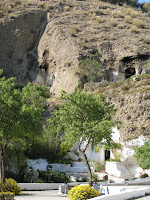
 A very colorful part of the Albaycin neighborhood is the Moorish market streets where lots of souvenirs, clothes, leather shoes, ceramics and water pipes(bongs?) are sold in tiny shops that spill out into the streets.
I have never been to Morocco but apparently this area is very much like markets there. If I was still 20, I probably would have spent some money here and bought myself some of the leather slippers, a skirt or two and maybe a bedspread just like in the 60's. There were rugs that tempted me, but with the dollar forcing me to add 60% to any price, it was easy for me to wander on. (What is the word for the opposite of discount?)
 All of this is now very tourism oriented especially since UNESCO declared the Alhambra a World Heritage Site. The good thing is that much is being done to restore the older character of the neighborhoods and to protect and display buildings, artifacts and information about the history of the lives and cultures of the area.
 Along the river is a narrow street, mostly used by pedestrians, artists, dogs, taxis and tiny electric buses much like my favorite #117 in Rome. This street, the Carrera de Darro, connects two popular plazas and has several bridges along it that cross the river. Many of the houses in the area are being restored with some being used for hotels like mine.
 On the Sunday I was there, I wandered up through the Albaycin for the third time - there is no way and no reason to take the same walk thrice in this neighborhood. Later, I returned to the river to find at least a dozen artists set up on the bridges painting. Lots of people were outside eating paella, "leafsheet of grapevine refill with rice and spices," or Spanish "tortilla" (a kind of omelette). And, of course, lots and lots of kids were wandering around, playing music, watching street performers or just hanging out. This is a town especially popular with students, clearly and understandably!
Late in March we had visits from a couple of Bill's former students, Thomas and Gasper. While they toured much of the center of the city with Bill, I decided to preview the church of San Clemente recommended to me by the amazing Sarah, whose suggestions have never failed. And indeed, this church should be on everyone's must see list. San Clemente is a 12th century church that was taken over by the Dominicans in the 17th century. In 1857 Father Mullooly began excavations under the church. Later in the 1900's when a drain from here to the Colosseum was being cut even more layers were uncovered. (Drains cause lots of things to happen in Rome - you could argue that they are one of the most important and underappreciated wonders of Rome!) Excavations and restorations continue to this day through several layers of occupation representing nearly 2000 years of occupation at this site.
 Currently, the lowest level appears to be from the time of Nero's fire that leveled the whole area over which the church now stands. I say over because in Nero's time the ground was fully 60 feet below the present ground level. Some of the buildings that have been on this site since the fire include a large Roman house, with courtyard, a Mithraic temple from around the turn of the 3rd century, a 4th century church and 5th or 6th century catacombs.
There seems to have been quite a bit of religious activity on this site. During Roman Imperial times, Mithraism was a rather moralistic religion celebrated only by men, many of them in the Roman army. The Mithraic temple on the lowest level of the site appears to have been "built in the centre of a small courtyard belonging to a first-century insula or apartment house. [...] Here there took place the ritual meal that commemorated the victory banquet of Apollo and Mithras before the latter ascended to the Heavens." (Leonard Boyle, O.P., St. Clement's Rome.) Some think that an adjacent room was a Mithraic school of some kind. Christians may have had secret meetings in the Roman house at the lowest level. It is thought that the family owning the house was called Clemens and that eventually as Christianity became accepted in Rome, their house was converted to a church dedicated to Pope Clement.Unfortunately, no photography is allowed in the lower levels of the church, but at least I can show you a bit of the church itself and this interesting box that was sitting in the courtyard. 
 A little research thanks to Wikipedia, suggests that the writing around the figure is in a script called Glagolitic and was invented by Saint Cyril and his brother Saint Methodius, two of the "Apostles of the Slavs," who were preaching in vernacular Slavic and needed a way to write a translation of the Bible into Slavic.
As with so many Saints, there is a story that Saint Clement himself was martyred. He was the 4th Pope in Rome but was supposedly exiled to the Crimea and eventually drowned by the Romans for being too successful a preacher. They tied him to an anchor and tossed him into the Black Sea. According to Boyle's guide book to the church, there is no actual evidence of this martydom but there is a lovely (later) story relating to it involving all three of these saints. Apparently SS. Cyril and Methodius, in their travels, found the tomb of Clement which was has been built by angels under the water of the Sea of Azov. Once a year, the tide recedes enough for the tomb to be seen. One year, a young boy was caught by the returning tide and drowned. However, the next year, when the tide again withdrew and revealed the tomb, the child was found, safe and sound, inside the tomb! There is a beautiful fresco illustrating this story in the remains of the 4th century church. This fresco was painted towards the end of the 11th century (in case you were wondering how the timing worked!).
Hundreds of years after the death of Clement, the Cyril and Methodius traveled to the Crimea and "miraculously recovered" Clement's body and even the anchor to which it was tied from the tomb and brought them back to Rome to be interred in this church. Plenty of miracles to go around and plenty of subjects for medieval art. This church and its history is long and full of facts and stories, and I apologize for barely even beginning to touch on them here. Luckily there are plenty of resources if you, Dear Reader, would like to explore more.
 The #32 bus, a tiny electrified box with only 9 seats including the driver's, but at least 20 passengers, bounces up the steep and narrow streets to, almost!, the visitor's center of the Alhambra. We all get out and mill around for a few seconds trying to orient ourselves. Further up the hill at the center, there always seems to be a long line with people in it telling you they've been there at least an hour. On the other hand, if you have a money card with a PIN you can bypass the line and go to the computers and buy your tickets immediately. Why do so many people wait in line? The voices over the intercoms that suggest the machines speak at least four languages, most visitors should understand at least one. It's the lack of the PIN that does it, I think... Or maybe we are all just sheep!
 Last post I left off in the Mexuar Palace, the first that visitors encounter. This shot is a look back at the "Golden Chamber" where it is thought that visitors in the days of the Moors waited in the hopes of an audience with the Sultan.
 The Golden Chamber has a beautiful view, of course, but also an incredible ceiling which is mostly original with some Catholic motifs and lots of gold added during later restorations. This type of work is called Mudejar and is a kind of carved wooden mosaic. After Baobdil was defeated, many Moorish craftsmen were allowed to stay and continued to work on Christian buildings. This is one of the reasons southern Spain looks the way it does even today.
 is the "facade" of the next palace, the Comares Palace. I use quotes because this architecture didn't really have facades; it was very plain on the outside and only became sumptuous on the inside. So, you can't really call it showy, I think, since its form and decoration was more for the comprehension and pleasure of the occupants than it was an outward show of wealth or power. Hard to see in these photographs are the many inscriptions in the wall carvings that include poetry and admonishments to good behavior.
 at the beautifully carved eaves of the entrance to the Comares Palace.
 The reference to myrtles is to the shrubs that run along the length of the huge pool in the center of the courtyard. Rub your fingers on the leaves and you get a lovely smell.
 Here is a closeup of some of the carving on the walls. (Could it really be stucco? I will have to look this up!)
 This shot is of one of the many small alcoves (on the order of 20" high by 15"wide) that are in the doorways. Apparently they were used hold pitchers of water or vases of flowers for the refreshment of visitors on entering.


